
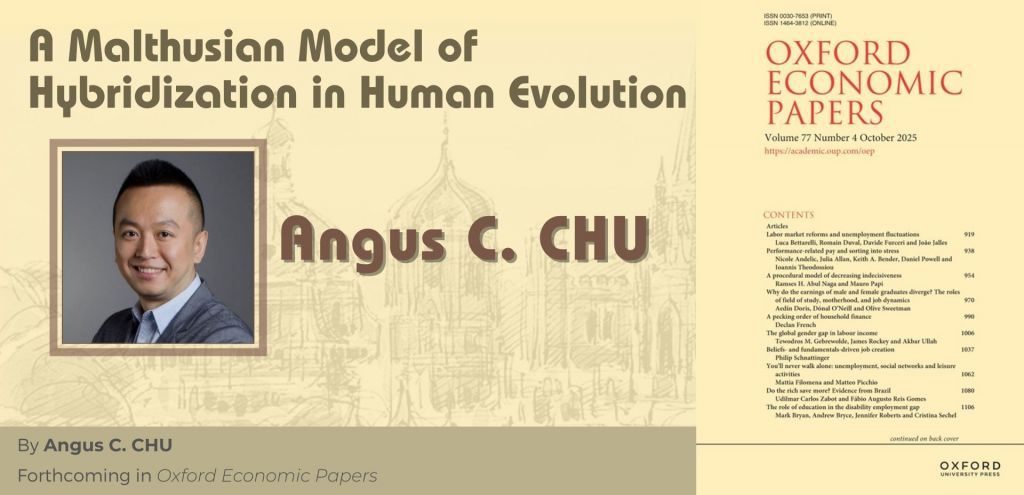
A Malthusian Model of Hybridization in Human Eevolution
By Angus C. CHU
Forthcoming in Oxford Economic Papers
Abstract:
Early modern humans interbred with archaic humans. We explore this phenomenon through an economic lens to reveal what shaped the origins of our species. In a Malthusian growth model with initial non-hybrid humans, we derive population dynamics and the conditions for hybrid humans to emerge and survive, which explains why modern humans still carry DNA from archaic humans. It is possible for a higher hybridization rate to reduce long-run population size and raise long-run output per capita. A sufficiently high hybridization rate causes only hybrid humans to survive. This result captures the probable scenario that all modern humans are hybrid descendants of archaic and early modern humans and provides the following novel insight: modern humans, which emerged from interbreeding, caused the extinction of archaic and early modern humans. Finally, our analysis also shows that the low proportion of Neanderthal-derived DNA in modern humans is due to their relatively early extinction.